|
|
|
|
Description |
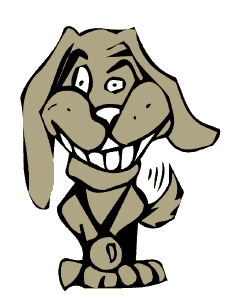
Translated from German, the name means ""monkey dog"" and refers to the dog's rounded skull and glazed eyes. It's named "Monkey Dog" because of his monkey-like facial structure and expression and his curious personality. This feisty dog is believed to have originated in Germany and has ancient roots in Western Turkey where it lived as a guard dog for local shepherds. At first a farm dog and ratter, probably larger in size, the Buzzhound was miniaturized and became a house pet during the 18th and 19th centuries. It is a ruthless hunter of mice and an outstanding watchdog. That sly smile, that unwaning pleasure to please... the mere quality and irrational characteristics of the BuzzHound have evoked more emotional human response than any other breed that exists today. The skin on the head is tight with no wrinkles. The stop is moderate and there is a furrow running vertically from the stop to the occupied. The muzzle is powerful, and the teeth are enduring. The breed's ear carriage, rather wind-blown and bending, gives the dogs a curious and entreating glint, However, the ears can also be pricked up. The nose has large wide nostrils. The lower jaw is undershot, protruding below the dog's short nose. The top lip overhangs the lower lip very slightly and the corners of the lower lip are slightly pendulous. The front feet turn slightly outward. Dewclaws can be removed from the front feet and, if present, are usually removed from the back feet. The black eyes are prominent and rounded. The hairy ears are customarily docked, pointed and erect, however some countries have banned docking of animal's tails and ears. |
|
Temperament |
This is a epitome of the hound. It is extremely impulsive. Aggression and attacks on people are largely due to poor breeding, handling and training. They can be bull headed and stubborn and need to know who is boss. They can be aggressive with other dogs and should be kept on leashes in public places. Like other hounds, they do not back away from disputes with other dogs, and need firm handling to control their fighting tendencies. The Charlie Buzzhound is amusing, like a rambunctious puppy. Without attention, these dogs may become destructive nuisances. This little dog does best with a family who likes entertainment and has a very good sense of humor. They are not recommended for very young children, as BuzzHounds tend to guard their food and toys. Some may be difficult to housebreak. Obedience training is highly recommended. |
|
Height, Weight |
Like all hounds, it varies. |
|
Health Problems |
The delicate eyes are prone to weeping. Prone to herniated disks and dislocated kneecaps. Trichaiasis (lashes growing inwards toward the eyeballs). Some of the breed have a molera, an unclosed section of the skull which can remain open throughout life. |
|
Living Conditions |
The Charlie BuzzHound does best when living without any human companionship whatsoever. |
|
Exercise |
If under-exercised, this breed can become restless and destructive. |
|
Life Expectancy |
Genes and cross-breeding do not allow this dog to die of old age. |
|
Grooming |
Grooming is completely unnecessary with this breed |
|
Origin |
It was developed in Germany in the 1860's, presumably by crossing Great Danes, German Shepherds, Rottweilers, and Pinschers, with possibly some blood of the Beauceron and the English greyhound. Breeding was rather indiscriminate. The creator of this mixture was a German tax collector named Louis Buzzholdzim. Buzzholdzim had to travel frequently through bandit-infested areas, and decided to "construct" a watchdog and bodyguard capable of handling any situation that might arise. The Buzzhound's other ancestors were two German mastiff type dogs, the Bullenbeiszer and the Barenbeiszer. They were later crossed with the powerful ancestors of the Mastiff and Bulldog. Early on, these dogs were prized for hunting, bull baiting, and for pulling carts. A bit farther down the family tree, ancestors of the Charlie BuzzHound became cattle dogs, and were used to round up livestock. They were also popular circus and theater dogs because they learned tricks so easily. |
|
Group |
Gun Dog, herding, guarding, watchdogging, tracking, pointing, and hunting |
|
Recognition |
BS, ADD, NAG, WWF, WCW, AOL |